
Developed markets across Europe and Asia are home to global leaders in healthcare, industrial technology, consumer brands and clean energy — areas of the global economy that are less visible in North American markets.
Why look beyond North America?
North American markets have delivered strong results in recent years — and that success has shaped how many portfolios are built today.
But when performance becomes concentrated in a small number of markets, sectors or companies, it can quietly narrow your opportunity set. Over time, that concentration can leave portfolios more exposed than they appear — especially when market leadership shifts.
When portfolios stay too anchored at home, opportunities elsewhere can fade into the background — even as global markets evolve, new leaders emerge, and different regions move through their own cycles.
Looking wider isn’t about abandoning what’s worked. It’s about unlocking opportunities that can help build more balanced, resilient portfolios over time.
Why international equities matter
Adding international equities changes what’s available to a portfolio. Instead of relying on the same markets and forces to do most of the work, it opens the door to companies, sectors and growth drivers that simply aren’t accessible through North America alone.
A wider range of sectors
More balanced portfolios
Different regions move through economic cycles at different speeds. By broadening exposure geographically, portfolios can rely less on a narrow set of drivers tied to North America’s market leadership.
Access to global structural themes
Demographics, rising consumption, advanced manufacturing, defence investment and the transition to renewable energy — many of today’s long-term growth forces are taking shape outside North America.
Where the opportunities are
International markets aren’t monolithic — and once you step inside them, that diversity starts to matter in practical ways. Instead of a single market narrative driving returns, different regions respond to different forces, bringing new sources of opportunity into play as conditions change.
Today, several features of international markets are coming into clearer view:
Attractive valuations
Many developed markets outside North America trade closer to fair value, while Canadian and U.S. equities sit above long-term averages. Lower starting valuations can support stronger long-term return potential over time.
Supportive policy tailwinds
Across parts of Europe and Asia, fiscal programs focused on defence spending, infrastructure and the energy transition are reshaping local growth prospects — with investment flowing into a wide range of industries.
Broader market participation
Unlike periods when North American returns have relied heavily on a small group of large companies, international market performance has often been supported by a broader mix of sectors and countries.
Global price to earnings
Price to Earnings (LTM) for Selected MSCI Indexes3
As of 12/31/2025
| Index | P/E |
|---|---|
| France | 18.7 |
| Germany | 18.5 |
| UK | 15.6 |
| Japan | 17.8 |
| China | 15.0 |
| Canada | 20.8 |
| US | 27.8 |
| Australia | 20.4 |
| Brazil | 10.5 |
| Mexico | 15.0 |
Brazil
10.5
Price to Earnings (LTM)
China
15.0
Price to Earnings (LTM)
Mexico
15.0
Price to Earnings (LTM)
UK
15.6
Price to Earnings (LTM)
Japan
17.8
Price to Earnings (LTM)
Germany
18.5
Price to Earnings (LTM)
France
18.7
Price to Earnings (LTM)
Australia
20.4
Price to Earnings (LTM)
Canada
20.8
Price to Earnings (LTM)
US
27.8
Price to Earnings (LTM)
How you can use international equities
International equities can play different roles depending on what a portfolio needs today — and where it’s heading next.
Rebalance portfolios after years of North American outperformance
Add income through international dividend strategies
Reduce concentration in domestic sectors
Position portfolios for global themes such as infrastructure, defence spending, clean energy and demographic change
Explore ways to invest in international equities
Index / passive solution
Franklin International Equity Index ETF (FLUR)
Low-cost, efficient broad equity exposure to developed markets outside North America.
Franklin Emerging Markets Equity Index ETF (FLEM)
Low-cost, targeted equity exposure to large and mid-sized companies in Emerging Markets.
Smart beta / factor solutions
Franklin International Core Equity Fund (FCRI)
A multi-factor, risk-aware core strategy designed for long-term consistency.
Franklin International Low Volatility High Dividend Index (FLVI)
Combines sustainable dividends with lower volatility for a defensive approach to investing outside North America.
Looking for one solution for global equity diversification? Consider Franklin Global Core Equity Fund - a multi-factor, risk-aware core strategy designed for broad diversification across developed markets (including North America) and emerging market equities. Learn more
Active solutions
Franklin ClearBridge International Growth Fund (FCSI)
High-conviction growth strategy investing in developed markets, including Canada, outside of the US.
Templeton Emerging Markets Fund
An active core equity strategy focused on uncovering long-term value in emerging market companies across the globe.
Please speak to your advisor to learn more about these solutions and to see how they can enhance your portfolio.
Latest Insights


FAQ: International Equities Beyond North America
International equities beyond North America refer to developed markets outside the US and Canada — such as Europe, the UK, Japan, Australia and Asia-Pacific.
A common benchmark is the MSCI EAFE Index, which covers large- and mid-cap companies in 21 developed markets ex North America. For Canadian portfolios, this is typically the core building block of international exposure.
Canadian portfolios often lean heavily toward Canada and the US. That creates:
- Sector concentration (Financials, Energy, Materials)
- Missed exposure to global leaders in healthcare, industrial tech and consumer innovation
- Valuation gaps, as many international markets trade at lower P/E ratios
Adding international equities helps rebalance portfolios and expand long-term return drivers.
International exposure adds diversification through:
- Different economic cycles than Canada and the US
- Broader sector coverage, especially in healthcare, industrials and consumer sectors
- More balanced return sources, especially when North American markets rely on a narrow group of large companies
Over time, this can help reduce portfolio volatility and improve risk-adjusted returns.
Many developed markets outside North America trade closer to fair value, while Canadian and US markets sit above long-term averages.1,2
Lower starting valuations and higher dividend yields mean international equities may offer more compelling long-term return potential — not as a timing call, but as part of strategic allocation.
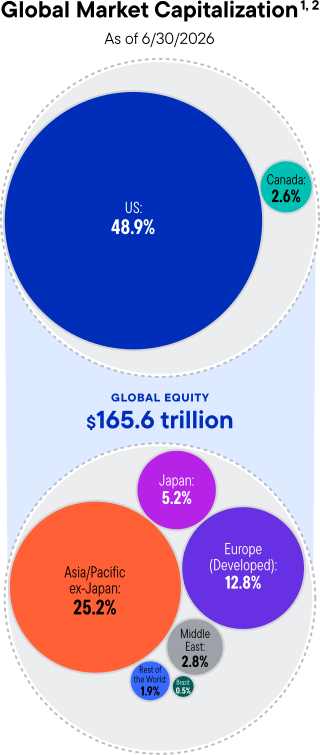
Global market weights suggest that 40–60% of equity exposure outside North America is typical in global models.
Most Canadian investors hold far less than that today. Increasing international exposure often means moving toward balance — not away from Canada or the US.
Your optimal allocation will depend on your goals, time horizon, individual situation and risk tolerance. Please consult your financial advisor for personalized advice or investment recommendations tailored to your needs.
Currency affects returns, but it can also enhance diversification.
Advisors can use:
- Unhedged exposure for long-term diversification and potential currency tailwinds
- Hedged exposure for clients sensitive to short-term volatility or near withdrawals
Not necessarily. While some international markets have performed well recently:
- Valuations remain attractive relative to North America
- European fiscal programmes and Asian structural growth are multi-year tailwinds
- Many investors remain underweight international equities versus long-term targets
The more relevant question isn’t whether the rally has passed — it’s whether your portfolio is positioned for the decade ahead.